Original: $3,599.00
-65%$3,599.00
$1,259.65The Story

World's Smallest Full-Feature 8K VR
Tiny Headset. Total Immersion.
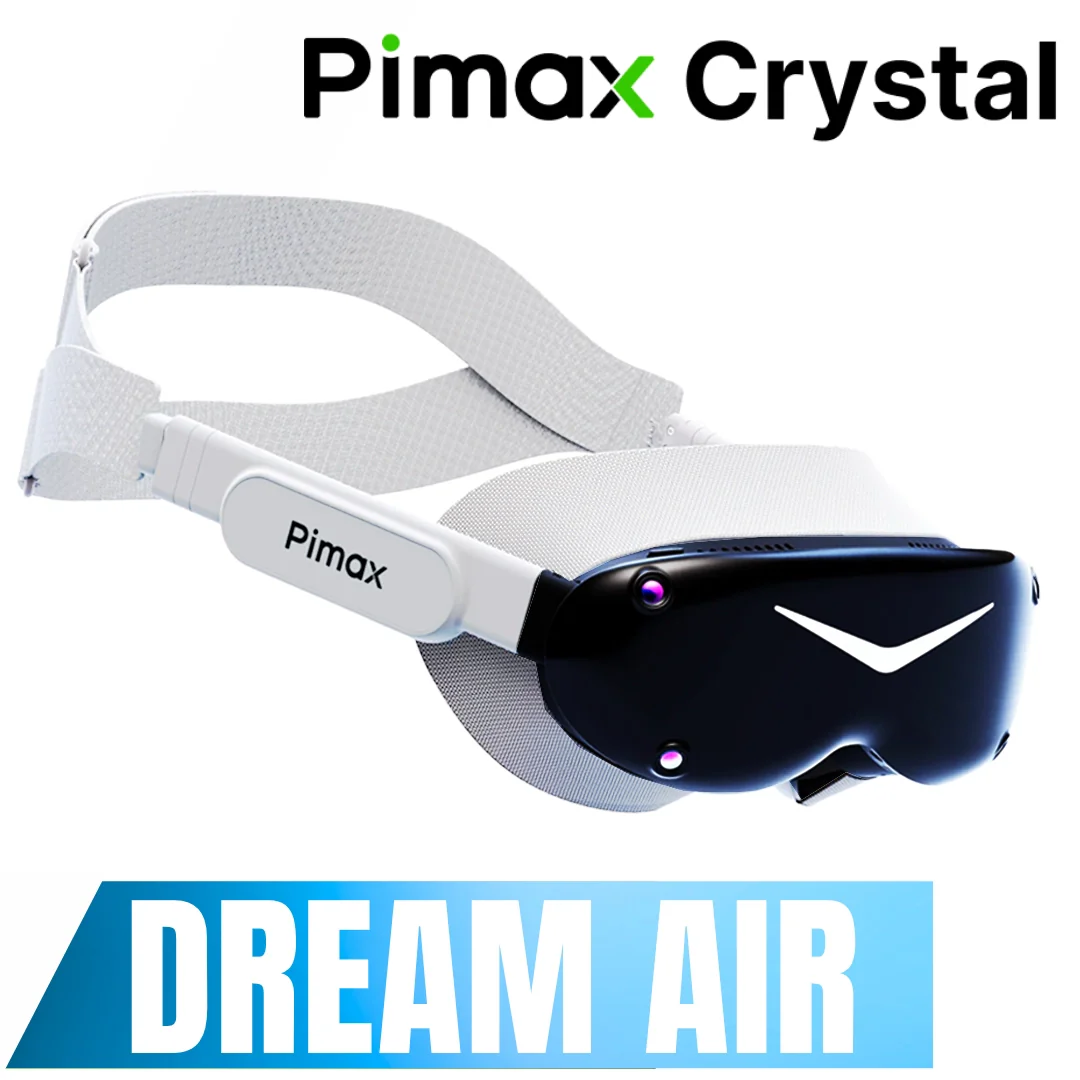
Sony Micro-OLED with infinite contrast. Around 170 grams. ConcaveView pancake optics with the widest field of view of any micro-OLED headset. 120 Hz eye tracking. The full-feature 8K-class PCVR experience — shrunk to the size of a pair of goggles, and backed by local Australian stock and support.

Why Dream Air
The biggest thing to happen to VR is this tiny
Sony Micro-OLED — infinite contrast
Two 1.35-inch Sony Micro-OLED panels deliver 3840 × 3552 per eye with true, self-lit blacks and infinite contrast. Night flying, deep-space scenes and dark cockpits look exactly as they should — no grey haze, no blooming.
ConcaveView pancake optics — widest micro-OLED FOV
Pimax's three-layer pancake lenses — with a concave top element — achieve the widest field of view of any micro-OLED VR headset while keeping clarity razor-sharp edge to edge. Up to 120° horizontal with a huge, forgiving sweet spot.
So light you forget you're wearing it
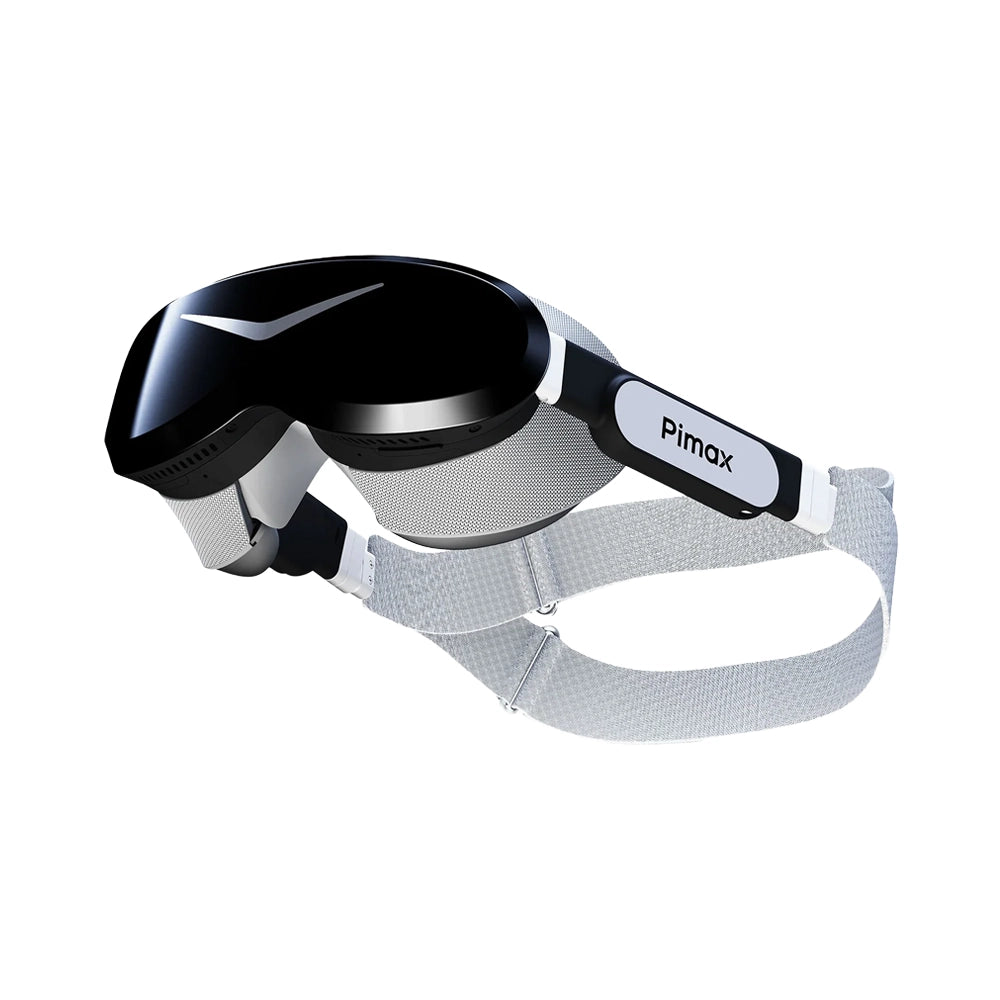
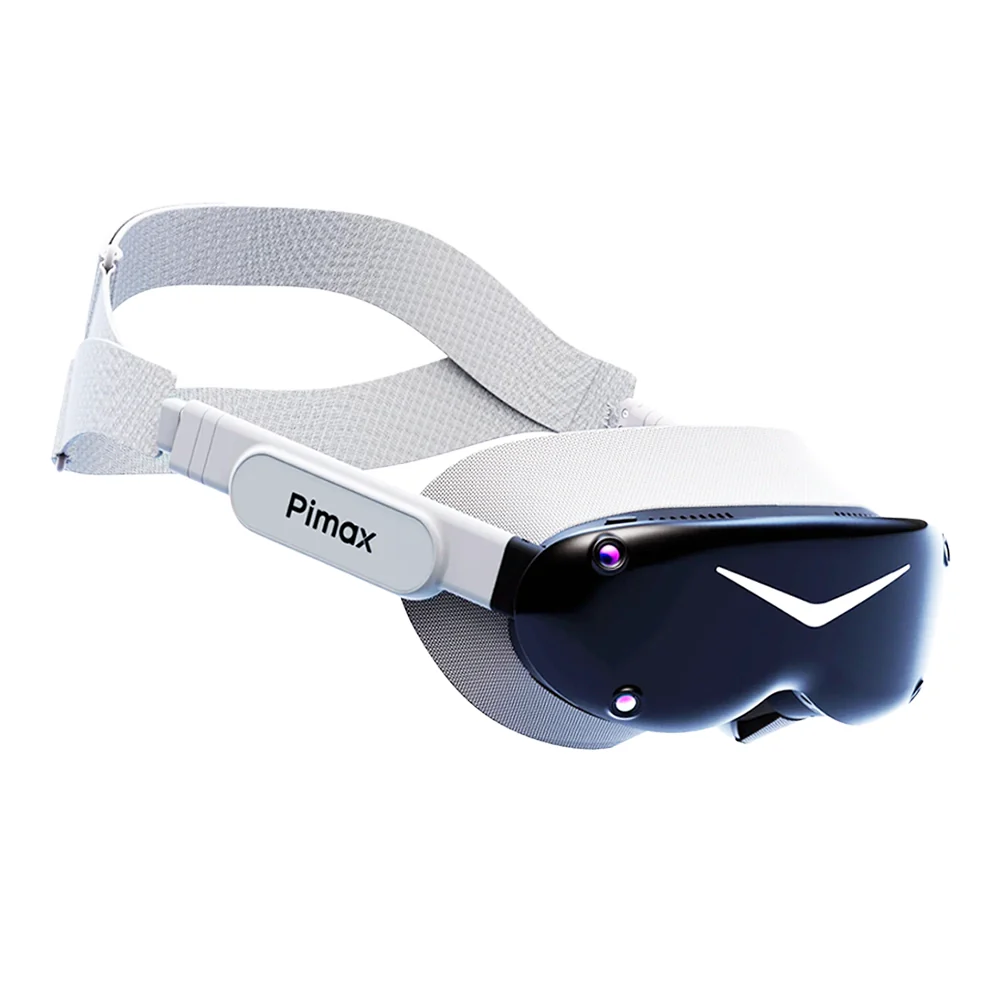
At around 170 grams the Dream Air all but disappears on your face. The ergonomic facemask and backstrap are both easily modifiable, so you can dial in a perfect, fatigue-free fit for marathon race stints and long-haul flights.
120 Hz eye tracking + Dynamic Foveated Rendering
Built-in eye tracking runs at 120 Hz and powers Dynamic Foveated Rendering — your PC renders full detail only where your eyes are actually looking. The result is an enormous performance boost that lets mainstream GPUs drive 8K-class visuals.
Uncompressed visuals over DisplayPort
The Dream Air is a true PCVR headset — a direct DisplayPort 1.4 connection feeds pixel-perfect, uncompressed images with none of the artefacts or latency of wireless streaming. What your GPU renders is exactly what you see.
Your choice of tracking — SLAM or Lighthouse
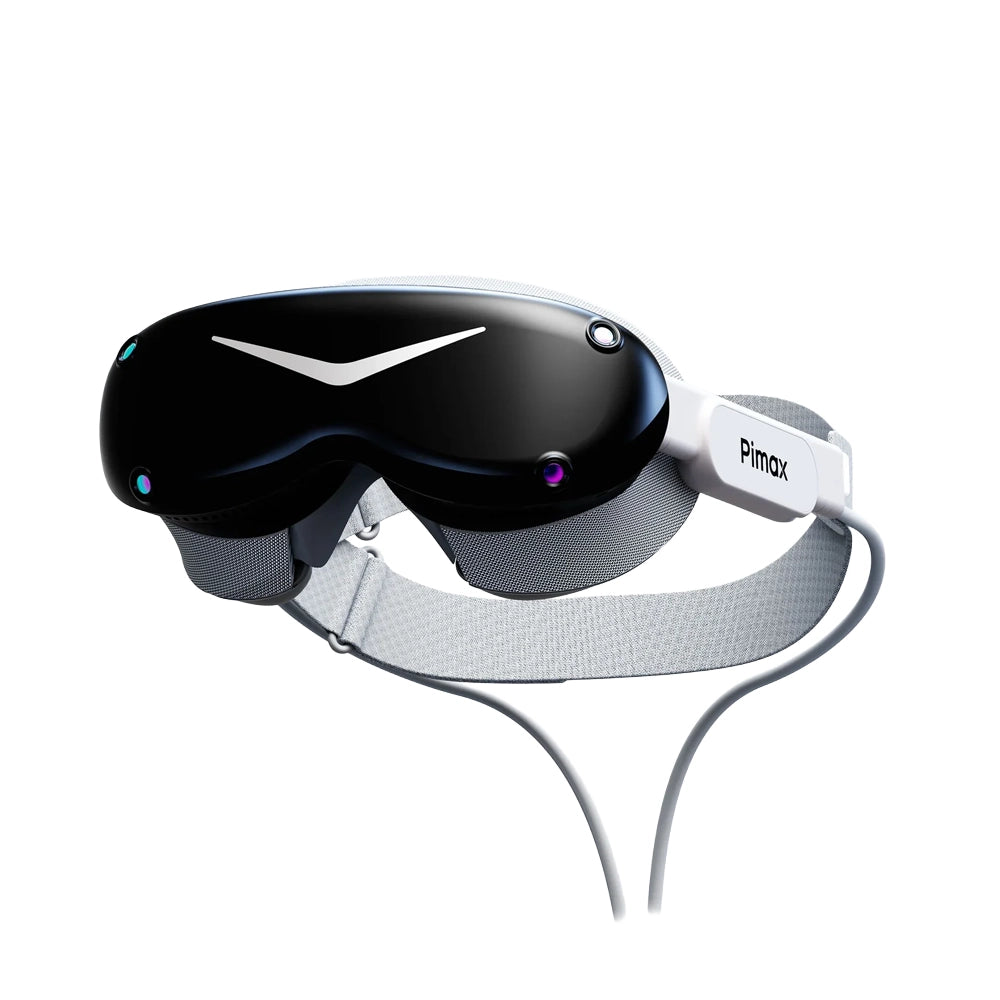
Pick inside-out SLAM tracking (four on-board cameras, ringless controllers, zero base stations) for the simplest setup, or the Lighthouse edition for SteamVR base-station precision if you already run a Lighthouse ecosystem.
The widest field of view of any small-form-factor headset
Most ultra-compact VR headsets trade away your peripheral vision. The Dream Air doesn't. Its proprietary three-element ConcaveView pancake optics wrap the virtual world around you with up to 120° of horizontal field of view (adjustable in Pimax Play), while the concave top layer keeps text, gauges and distant detail crisp right across the lens. The sweet spot is large and forgiving — so the image stays sharp even as your eyes dart around the cockpit.

Featherweight comfort, built for long sessions
Weighing in at roughly 170 grams, the Dream Air is a fraction of the mass of a traditional PCVR headset. There's no front-heavy pull and no need for elaborate counterweights. The ergonomic facemask spreads contact evenly, the backstrap cradles the back of your head, and both are easily moddable — swap pads, adjust tension and tune the fit to your exact face shape.

Eye tracking that pays for itself in frames
Eye tracking at 120 Hz drives Dynamic Foveated Rendering (DFR): the GPU only renders full, native-resolution detail in the small area you're directly looking at, and intelligently softens the periphery your eyes can't resolve anyway. You can't see it working — but you'll feel it in the frame rate. DFR is what makes 8K-class clarity playable on mainstream graphics cards.
Choose your configuration
Two editions — one featherweight headset
Both editions share the identical headset: the same Sony Micro-OLED panels, ConcaveView pancake optics, 120 Hz eye tracking, integrated audio and around-170-gram comfort. The only difference is how it tracks your movement — and whether controllers are included.
Dream Air SLAM Edition
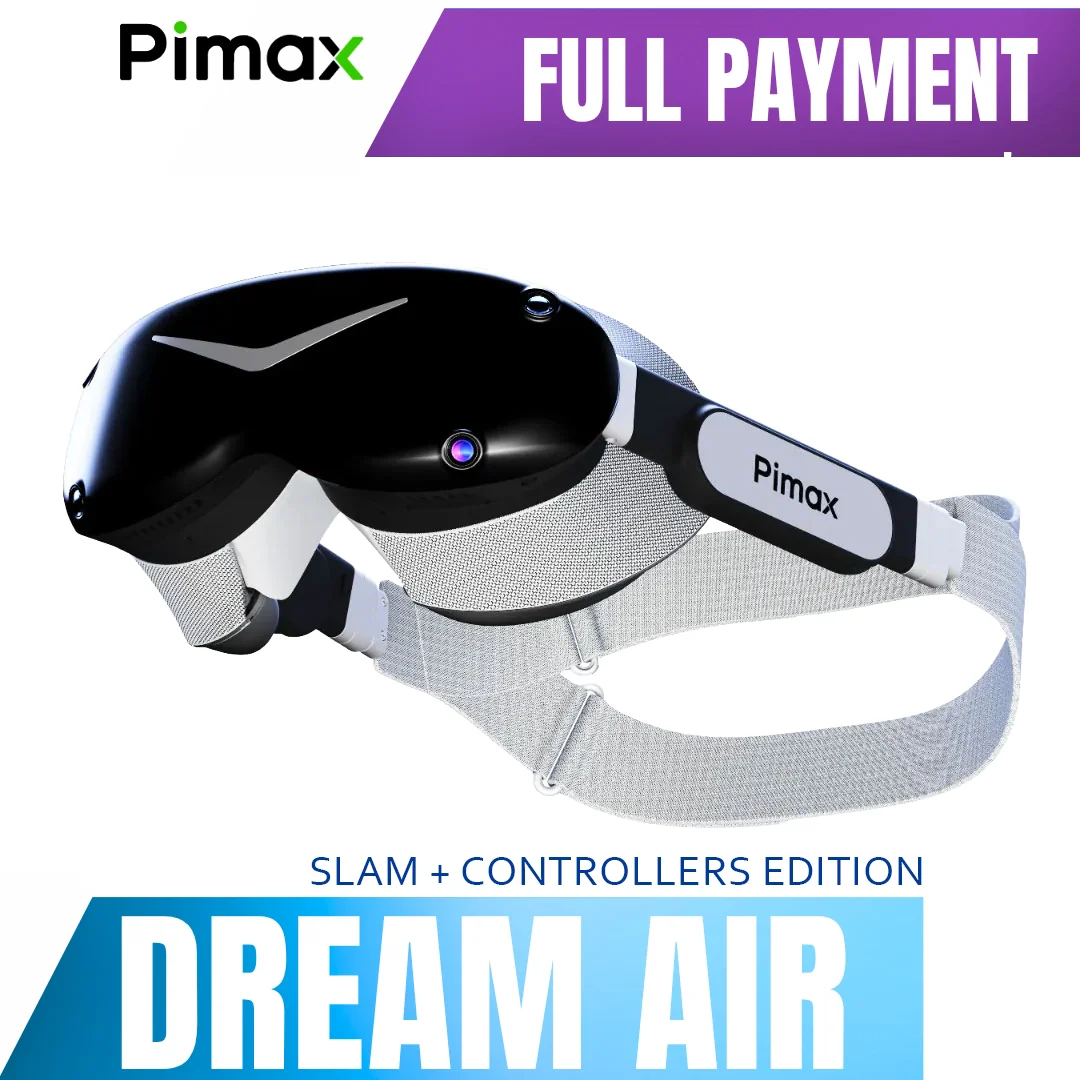
Inside-out tracking + controllers included
- TrackingInside-out SLAM
- Cameras4 on-board
- Controllers2× ringless, included
- Base stationsNot required
- Setup timeMinutes
Dream Air Lighthouse Edition
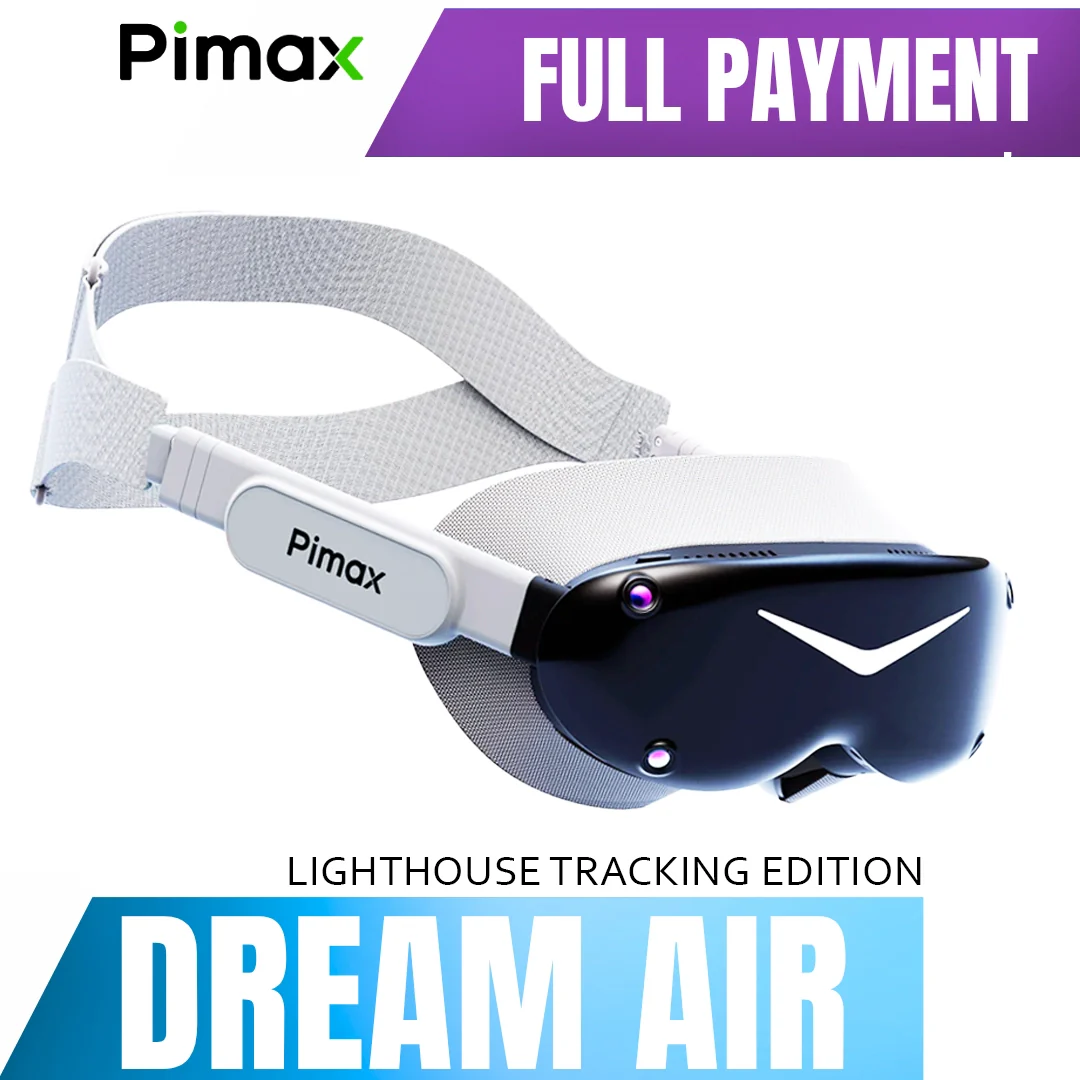
Headset only — SteamVR base-station tracking
- TrackingSteamVR Lighthouse
- FaceplateClick-on Lighthouse
- ControllersUse your own
- Base stationsRequired (not incl.)
- PrecisionSub-mm SteamVR
Side-by-side
SLAM vs Lighthouse
| Feature | SLAM Edition | Lighthouse Edition |
|---|---|---|
| Tracking method | Inside-out (SLAM) | SteamVR base stations |
| Controllers | 2× ringless, included | Use your own SteamVR |
| Base stations needed | No | Yes (not included) |
| Setup complexity | Minimal | Moderate |
| Tracking precision | Excellent | Sub-mm reference |
| Best for | Most buyers | Existing Lighthouse owners |
Pimax Prime — flexible payment option
Try it first. Pay the rest only if you love it.
Pimax Prime is a two-step payment program. You pay a lower amount upfront, receive the headset, and have 14 days to decide before paying the remainder.
Pay the entry price & receive your headset
No credit check, no financing approval. Order the Prime version and your Dream Air ships with everything included for your chosen edition.
Try it at home — risk free
VR is personal — every face, every pair of eyes is different. Pimax Prime gives you a genuine trial window to decide for yourself, in your own sim.
Pay the Prime fee to keep it — or send it back
Love it? Pay the one-time Prime fee via the Pimax Play app and it's yours forever — no subscription, no ongoing cost. Not for you? Return it for a refund less shipping and a 10% restocking fee.
Retailer note: On the Prime version you pay the entry price to us; the remaining Prime fee is paid directly to Pimax via the Pimax Play app (in USD) after your 14-day trial. Full-payment versions are also available — these include the complete cost with no secondary fee. All prices in AUD inc. GST.
Technical specifications
Dream Air — full spec sheet
Compare the Pimax range
Dream Air vs Crystal Light & Crystal Super
How the featherweight Dream Air compares to Pimax's full-size Crystal Light and the three Crystal Super optical engines. Tap any headset to view it on Player1 Sim Gear.
| Specification | Dream AirSLAM edition | Dream AirLighthouse edition | Crystal LightQLED | Crystal Super50 PPD QLED | Crystal Super50 PPD Ultrawide | Crystal Super8K Micro-OLED |
|---|---|---|---|---|---|---|
| Panel | Sony Micro-OLED | Sony Micro-OLED | QLED (mini-LED) | QLED | QLED | Sony Micro-OLED |
| Resolution / eye | 3840 × 3552 | 3840 × 3552 | 2880 × 2880 | 3840 × 3840 | 3840 × 3840 | 3840 × 3552 |
| PPD (pixels/degree) | — | — | 35 | 50 | 50 | 53 |
| Horizontal FOV | Up to 120° | Up to 120° | 105° | 127° (138° Labs) | 140° | 116° |
| Refresh rate | 72 / 90 Hz | 72 / 90 Hz | 72 / 90 / 120 Hz | 72 / 90 Hz | 72 / 90 Hz | Up to 90 Hz |
| Lenses | Pancake (ConcaveView) | Pancake (ConcaveView) | Glass aspheric | Glass aspheric | Glass aspheric | Pancake |
| Eye tracking | 120 Hz | 120 Hz | No (Fixed FR) | Yes | Yes | Yes |
| Tracking | Inside-out SLAM · controllers incl. | SteamVR Lighthouse · BYO controllers | Inside-out · Lighthouse-ready | Inside-out · Lighthouse-ready | Inside-out · Lighthouse-ready | Inside-out · Lighthouse-ready |
| Size & weight | Ultra-compact · ~170 g | Ultra-compact · ~170 g | Full-size headset | Full-size headset | Full-size headset | Full-size headset |
FOV and PPD figures published by Pimax. "—" = not published by the manufacturer. The Crystal Super 50 PPD QLED reaches 138° horizontal in Labs mode. All three Crystal Super optical engines run in a single Crystal Super headset. Specifications are subject to change by the manufacturer.
What's included
In the box
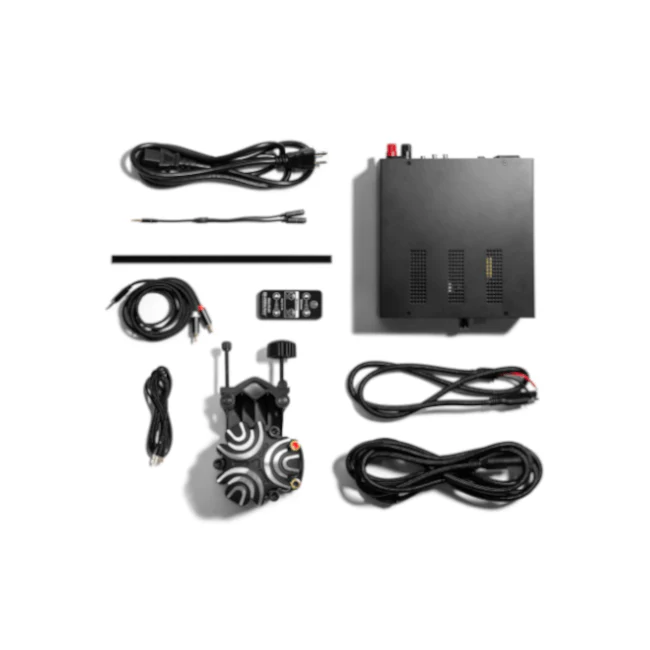
The Lighthouse edition is headset-only and uses your existing SteamVR base stations and controllers (Lighthouse faceplate may be required). Prescription diopter inserts and the DMAS audio hardstrap are available separately. Final inclusions are confirmed by edition at checkout.
Peace of mind
Warranty & returns
12-month hardware warranty
Any fault through no fault of the user is repaired or replaced at no cost, including all shipping charges — handled locally in Australia.
14-day return guarantee
Every new Dream Air is covered by a 14-day return window. Change-of-mind returns incur a 10% restocking fee plus return shipping; faulty units are covered in full. See the full Pimax returns policy.
Pimax Prime — try before you commit
Pay the entry price upfront, receive the headset, and take 14 days before paying the remainder. Return for a refund less shipping and a 10% restocking fee if it's not for you.
Common questions
Frequently asked questions
How is the Dream Air different from the Crystal Super?
Internally they're close cousins — the Dream Air is essentially the Sony Micro-OLED optical engine of the Crystal Super shrunk into a tiny, ~170-gram pancake-lens body. Choose the Dream Air if you want the smallest, lightest possible full-feature 8K-class headset with true OLED blacks. Choose the Crystal Super if you want a larger QLED panel, aspheric lenses, higher PPD options (50/57 PPD) and an even wider field of view (up to 140°). Both run on Pimax Play and share the same controller technology.
Should I buy the SLAM edition or the Lighthouse edition?
For most people, the SLAM edition is the right choice — it tracks itself using four on-board cameras, includes two ringless controllers, and needs no external base stations, so you're up and running in minutes. Choose the Lighthouse edition only if you already own SteamVR base stations and controllers and want their sub-millimetre tracking precision; it ships as headset-only and uses a click-on Lighthouse faceplate. Not sure? Call us on 0488 385 870 and we'll point you to the right one.
Do I need base stations to use the Dream Air?
Only for the Lighthouse edition. The SLAM edition uses inside-out tracking with four built-in cameras and requires no external sensors at all. The Lighthouse edition is designed for people who already run a SteamVR base-station setup.
What graphics card do I need?
The minimum is roughly an NVIDIA RTX 2070/2080, and we recommend an RTX 3070 or higher for sim racing and flight at full quality. Thanks to Dynamic Foveated Rendering and adjustable render resolution, the Dream Air is easier to drive than larger PCVR headsets — but more GPU headroom always means higher settings and smoother frame rates. You'll also need a DisplayPort 1.4 output and a USB 3.0 port.
Is the Dream Air wireless?
No. The Dream Air is a PCVR-only headset that connects to your PC via a DisplayPort 1.4 + USB cable for uncompressed, low-latency visuals. It does not support wireless streaming or standalone operation.
Does it work with my existing Steam VR library?
Yes. The Dream Air runs all SteamVR, OpenXR and OpenVR applications through Pimax Play, so your existing PCVR library — DCS World, MSFS 2024, iRacing, Assetto Corsa and the rest — works out of the box.
I wear glasses — can I still use it?
Yes. The Dream Air has automatic IPD adjustment across a 58–72 mm range, and Pimax offers custom diopter (prescription) lens inserts from −300 to +900 degrees, sold separately, so most users can go glasses-free. Contact us if you'd like help ordering the right inserts for your prescription.
What is Pimax Prime, and what happens if I don't pay the fee after my trial?
Pimax Prime lets you pay a lower entry price upfront, try the headset for 14 days, then pay a one-time Prime fee via the Pimax Play app to keep it permanently — no subscription, no ongoing cost. If the Prime fee isn't paid after the trial, the Pimax Play software stops functioning until you complete the one-time payment. The Prime status is tied to the headset and transfers with it if you ever sell it. Full-payment versions with no secondary fee are also available.
What else do I need to complete my sim setup with the Dream Air?
The Dream Air is a PCVR headset — it needs a capable gaming PC (RTX 3070+ recommended) with a DisplayPort 1.4 output. Beyond that, your ideal setup depends on your discipline. For sim racing you'll want a direct-drive wheelbase and load-cell pedals (we stock Moza, Simagic, Simucube and Heusinkveld), a sturdy cockpit (Trak Racer and Next Level Racing are favourites), and optionally a motion platform or ButtKicker for haptics. For flight simulation you'll want a HOTAS or yoke and throttle, rudder pedals and a flight cockpit. Player1 Sim Gear stocks the lot — browse our Sim Packages, Racing Cockpits and Wheel & Pedal Combos. Not sure where to start? Call us on 0488 385 870.
Do you ship the Dream Air Australia-wide, and how long does delivery take?
Yes — we ship the Dream Air right across Australia, metro and regional. Player1 Sim Gear is an official Australian Pimax distributor, so stock is held and supported locally rather than imported on demand. Delivery timeframes vary by location and stock availability — contact us on 0488 385 870 or via our contact page for current lead times and express options. All orders are trackable and insured.
Why buy the Pimax Dream Air from Player1 Sim Gear rather than overseas?
Player1 Sim Gear is an official Australian Pimax distributor. Buying from us means your warranty is honoured locally — no shipping your headset overseas for repairs, no grey-market support gaps. You get full Australian Consumer Law protection, local warranty handling, Australian stock, GST-inclusive pricing with a valid tax invoice, and a real person to call on 0488 385 870. Our team uses this gear every day and can help you choose the right edition and GPU for your sim.
Build the full experience
Complete your sim setup
The Dream Air delivers tiny-and-light, infinite-contrast visuals — pair it with the right cockpit, controls and haptics to match.


Not sure which edition is right for you?
Our team uses this gear every day — we fly DCS World and Microsoft Flight Simulator 2024 in VR, and race iRacing and Assetto Corsa Competizione too. We'll help you choose between SLAM and Lighthouse and match the Dream Air to your PC and your sim.
Details & Craftsmanship
Every detail has been carefully considered to bring you the perfect product.
Details & Craftsmanship
Every detail has been carefully considered to bring you the perfect product.
Details & Craftsmanship
Every detail has been carefully considered to bring you the perfect product.
Details & Craftsmanship
Every detail has been carefully considered to bring you the perfect product.

Details & Craftsmanship
Every detail has been carefully considered to bring you the perfect product.
Details & Craftsmanship
Every detail has been carefully considered to bring you the perfect product.
Description
World's Smallest Full-Feature 8K VR
Tiny Headset. Total Immersion.
Sony Micro-OLED with infinite contrast. Around 170 grams. ConcaveView pancake optics with the widest field of view of any micro-OLED headset. 120 Hz eye tracking. The full-feature 8K-class PCVR experience — shrunk to the size of a pair of goggles, and backed by local Australian stock and support.
Why Dream Air
The biggest thing to happen to VR is this tiny
Sony Micro-OLED — infinite contrast
Two 1.35-inch Sony Micro-OLED panels deliver 3840 × 3552 per eye with true, self-lit blacks and infinite contrast. Night flying, deep-space scenes and dark cockpits look exactly as they should — no grey haze, no blooming.
ConcaveView pancake optics — widest micro-OLED FOV
Pimax's three-layer pancake lenses — with a concave top element — achieve the widest field of view of any micro-OLED VR headset while keeping clarity razor-sharp edge to edge. Up to 120° horizontal with a huge, forgiving sweet spot.
So light you forget you're wearing it
At around 170 grams the Dream Air all but disappears on your face. The ergonomic facemask and backstrap are both easily modifiable, so you can dial in a perfect, fatigue-free fit for marathon race stints and long-haul flights.
120 Hz eye tracking + Dynamic Foveated Rendering
Built-in eye tracking runs at 120 Hz and powers Dynamic Foveated Rendering — your PC renders full detail only where your eyes are actually looking. The result is an enormous performance boost that lets mainstream GPUs drive 8K-class visuals.
Uncompressed visuals over DisplayPort
The Dream Air is a true PCVR headset — a direct DisplayPort 1.4 connection feeds pixel-perfect, uncompressed images with none of the artefacts or latency of wireless streaming. What your GPU renders is exactly what you see.
Your choice of tracking — SLAM or Lighthouse
Pick inside-out SLAM tracking (four on-board cameras, ringless controllers, zero base stations) for the simplest setup, or the Lighthouse edition for SteamVR base-station precision if you already run a Lighthouse ecosystem.
The widest field of view of any small-form-factor headset
Most ultra-compact VR headsets trade away your peripheral vision. The Dream Air doesn't. Its proprietary three-element ConcaveView pancake optics wrap the virtual world around you with up to 120° of horizontal field of view (adjustable in Pimax Play), while the concave top layer keeps text, gauges and distant detail crisp right across the lens. The sweet spot is large and forgiving — so the image stays sharp even as your eyes dart around the cockpit.
Featherweight comfort, built for long sessions
Weighing in at roughly 170 grams, the Dream Air is a fraction of the mass of a traditional PCVR headset. There's no front-heavy pull and no need for elaborate counterweights. The ergonomic facemask spreads contact evenly, the backstrap cradles the back of your head, and both are easily moddable — swap pads, adjust tension and tune the fit to your exact face shape.
Eye tracking that pays for itself in frames
Eye tracking at 120 Hz drives Dynamic Foveated Rendering (DFR): the GPU only renders full, native-resolution detail in the small area you're directly looking at, and intelligently softens the periphery your eyes can't resolve anyway. You can't see it working — but you'll feel it in the frame rate. DFR is what makes 8K-class clarity playable on mainstream graphics cards.
Choose your configuration
Two editions — one featherweight headset
Both editions share the identical headset: the same Sony Micro-OLED panels, ConcaveView pancake optics, 120 Hz eye tracking, integrated audio and around-170-gram comfort. The only difference is how it tracks your movement — and whether controllers are included.
Dream Air SLAM Edition
Inside-out tracking + controllers included
- TrackingInside-out SLAM
- Cameras4 on-board
- Controllers2× ringless, included
- Base stationsNot required
- Setup timeMinutes
Dream Air Lighthouse Edition
Headset only — SteamVR base-station tracking
- TrackingSteamVR Lighthouse
- FaceplateClick-on Lighthouse
- ControllersUse your own
- Base stationsRequired (not incl.)
- PrecisionSub-mm SteamVR
Side-by-side
SLAM vs Lighthouse
| Feature | SLAM Edition | Lighthouse Edition |
|---|---|---|
| Tracking method | Inside-out (SLAM) | SteamVR base stations |
| Controllers | 2× ringless, included | Use your own SteamVR |
| Base stations needed | No | Yes (not included) |
| Setup complexity | Minimal | Moderate |
| Tracking precision | Excellent | Sub-mm reference |
| Best for | Most buyers | Existing Lighthouse owners |
Pimax Prime — flexible payment option
Try it first. Pay the rest only if you love it.
Pimax Prime is a two-step payment program. You pay a lower amount upfront, receive the headset, and have 14 days to decide before paying the remainder.
Pay the entry price & receive your headset
No credit check, no financing approval. Order the Prime version and your Dream Air ships with everything included for your chosen edition.
Try it at home — risk free
VR is personal — every face, every pair of eyes is different. Pimax Prime gives you a genuine trial window to decide for yourself, in your own sim.
Pay the Prime fee to keep it — or send it back
Love it? Pay the one-time Prime fee via the Pimax Play app and it's yours forever — no subscription, no ongoing cost. Not for you? Return it for a refund less shipping and a 10% restocking fee.
Retailer note: On the Prime version you pay the entry price to us; the remaining Prime fee is paid directly to Pimax via the Pimax Play app (in USD) after your 14-day trial. Full-payment versions are also available — these include the complete cost with no secondary fee. All prices in AUD inc. GST.
Technical specifications
Dream Air — full spec sheet
Compare the Pimax range
Dream Air vs Crystal Light & Crystal Super
How the featherweight Dream Air compares to Pimax's full-size Crystal Light and the three Crystal Super optical engines. Tap any headset to view it on Player1 Sim Gear.
| Specification | Dream AirSLAM edition | Dream AirLighthouse edition | Crystal LightQLED | Crystal Super50 PPD QLED | Crystal Super50 PPD Ultrawide | Crystal Super8K Micro-OLED |
|---|---|---|---|---|---|---|
| Panel | Sony Micro-OLED | Sony Micro-OLED | QLED (mini-LED) | QLED | QLED | Sony Micro-OLED |
| Resolution / eye | 3840 × 3552 | 3840 × 3552 | 2880 × 2880 | 3840 × 3840 | 3840 × 3840 | 3840 × 3552 |
| PPD (pixels/degree) | — | — | 35 | 50 | 50 | 53 |
| Horizontal FOV | Up to 120° | Up to 120° | 105° | 127° (138° Labs) | 140° | 116° |
| Refresh rate | 72 / 90 Hz | 72 / 90 Hz | 72 / 90 / 120 Hz | 72 / 90 Hz | 72 / 90 Hz | Up to 90 Hz |
| Lenses | Pancake (ConcaveView) | Pancake (ConcaveView) | Glass aspheric | Glass aspheric | Glass aspheric | Pancake |
| Eye tracking | 120 Hz | 120 Hz | No (Fixed FR) | Yes | Yes | Yes |
| Tracking | Inside-out SLAM · controllers incl. | SteamVR Lighthouse · BYO controllers | Inside-out · Lighthouse-ready | Inside-out · Lighthouse-ready | Inside-out · Lighthouse-ready | Inside-out · Lighthouse-ready |
| Size & weight | Ultra-compact · ~170 g | Ultra-compact · ~170 g | Full-size headset | Full-size headset | Full-size headset | Full-size headset |
FOV and PPD figures published by Pimax. "—" = not published by the manufacturer. The Crystal Super 50 PPD QLED reaches 138° horizontal in Labs mode. All three Crystal Super optical engines run in a single Crystal Super headset. Specifications are subject to change by the manufacturer.
What's included
In the box
The Lighthouse edition is headset-only and uses your existing SteamVR base stations and controllers (Lighthouse faceplate may be required). Prescription diopter inserts and the DMAS audio hardstrap are available separately. Final inclusions are confirmed by edition at checkout.
Peace of mind
Warranty & returns
12-month hardware warranty
Any fault through no fault of the user is repaired or replaced at no cost, including all shipping charges — handled locally in Australia.
14-day return guarantee
Every new Dream Air is covered by a 14-day return window. Change-of-mind returns incur a 10% restocking fee plus return shipping; faulty units are covered in full. See the full Pimax returns policy.
Pimax Prime — try before you commit
Pay the entry price upfront, receive the headset, and take 14 days before paying the remainder. Return for a refund less shipping and a 10% restocking fee if it's not for you.
Common questions
Frequently asked questions
How is the Dream Air different from the Crystal Super?
Internally they're close cousins — the Dream Air is essentially the Sony Micro-OLED optical engine of the Crystal Super shrunk into a tiny, ~170-gram pancake-lens body. Choose the Dream Air if you want the smallest, lightest possible full-feature 8K-class headset with true OLED blacks. Choose the Crystal Super if you want a larger QLED panel, aspheric lenses, higher PPD options (50/57 PPD) and an even wider field of view (up to 140°). Both run on Pimax Play and share the same controller technology.
Should I buy the SLAM edition or the Lighthouse edition?
For most people, the SLAM edition is the right choice — it tracks itself using four on-board cameras, includes two ringless controllers, and needs no external base stations, so you're up and running in minutes. Choose the Lighthouse edition only if you already own SteamVR base stations and controllers and want their sub-millimetre tracking precision; it ships as headset-only and uses a click-on Lighthouse faceplate. Not sure? Call us on 0488 385 870 and we'll point you to the right one.
Do I need base stations to use the Dream Air?
Only for the Lighthouse edition. The SLAM edition uses inside-out tracking with four built-in cameras and requires no external sensors at all. The Lighthouse edition is designed for people who already run a SteamVR base-station setup.
What graphics card do I need?
The minimum is roughly an NVIDIA RTX 2070/2080, and we recommend an RTX 3070 or higher for sim racing and flight at full quality. Thanks to Dynamic Foveated Rendering and adjustable render resolution, the Dream Air is easier to drive than larger PCVR headsets — but more GPU headroom always means higher settings and smoother frame rates. You'll also need a DisplayPort 1.4 output and a USB 3.0 port.
Is the Dream Air wireless?
No. The Dream Air is a PCVR-only headset that connects to your PC via a DisplayPort 1.4 + USB cable for uncompressed, low-latency visuals. It does not support wireless streaming or standalone operation.
Does it work with my existing Steam VR library?
Yes. The Dream Air runs all SteamVR, OpenXR and OpenVR applications through Pimax Play, so your existing PCVR library — DCS World, MSFS 2024, iRacing, Assetto Corsa and the rest — works out of the box.
I wear glasses — can I still use it?
Yes. The Dream Air has automatic IPD adjustment across a 58–72 mm range, and Pimax offers custom diopter (prescription) lens inserts from −300 to +900 degrees, sold separately, so most users can go glasses-free. Contact us if you'd like help ordering the right inserts for your prescription.
What is Pimax Prime, and what happens if I don't pay the fee after my trial?
Pimax Prime lets you pay a lower entry price upfront, try the headset for 14 days, then pay a one-time Prime fee via the Pimax Play app to keep it permanently — no subscription, no ongoing cost. If the Prime fee isn't paid after the trial, the Pimax Play software stops functioning until you complete the one-time payment. The Prime status is tied to the headset and transfers with it if you ever sell it. Full-payment versions with no secondary fee are also available.
What else do I need to complete my sim setup with the Dream Air?
The Dream Air is a PCVR headset — it needs a capable gaming PC (RTX 3070+ recommended) with a DisplayPort 1.4 output. Beyond that, your ideal setup depends on your discipline. For sim racing you'll want a direct-drive wheelbase and load-cell pedals (we stock Moza, Simagic, Simucube and Heusinkveld), a sturdy cockpit (Trak Racer and Next Level Racing are favourites), and optionally a motion platform or ButtKicker for haptics. For flight simulation you'll want a HOTAS or yoke and throttle, rudder pedals and a flight cockpit. Player1 Sim Gear stocks the lot — browse our Sim Packages, Racing Cockpits and Wheel & Pedal Combos. Not sure where to start? Call us on 0488 385 870.
Do you ship the Dream Air Australia-wide, and how long does delivery take?
Yes — we ship the Dream Air right across Australia, metro and regional. Player1 Sim Gear is an official Australian Pimax distributor, so stock is held and supported locally rather than imported on demand. Delivery timeframes vary by location and stock availability — contact us on 0488 385 870 or via our contact page for current lead times and express options. All orders are trackable and insured.
Why buy the Pimax Dream Air from Player1 Sim Gear rather than overseas?
Player1 Sim Gear is an official Australian Pimax distributor. Buying from us means your warranty is honoured locally — no shipping your headset overseas for repairs, no grey-market support gaps. You get full Australian Consumer Law protection, local warranty handling, Australian stock, GST-inclusive pricing with a valid tax invoice, and a real person to call on 0488 385 870. Our team uses this gear every day and can help you choose the right edition and GPU for your sim.
Build the full experience
Complete your sim setup
The Dream Air delivers tiny-and-light, infinite-contrast visuals — pair it with the right cockpit, controls and haptics to match.
Not sure which edition is right for you?
Our team uses this gear every day — we fly DCS World and Microsoft Flight Simulator 2024 in VR, and race iRacing and Assetto Corsa Competizione too. We'll help you choose between SLAM and Lighthouse and match the Dream Air to your PC and your sim.